What is actually running, across every client network
Rapitt is IT infrastructure monitoring for engineers responsible for servers they don't own, behind networks they don't control. It reaches inside every client VPN, reads each server, workstation and network device every five minutes, and gives every host a security grade from A to F — with the fix written next to each finding.
- Server security grading from 19 checks per host
- Multi-site monitoring — one tunnel per client network
- Workstations, printers, attendance terminals, routers and IoT
- Alerts by e-mail, SMS and WhatsApp
Request received
Thank you, . You'll be notified once the tenant is approved and deployed.
One console for servers, workstations and everything else on the network
Most IT teams that look after many sites live with the same three gaps. Each site is its own network, so seeing every server at once means a laptop and a dozen VPN connections. Nobody can say with evidence how safe a given host is. And half of what is on the wire — printers, biometric attendance terminals, routers, cameras and other IoT devices — sits in no monitoring tool at all.
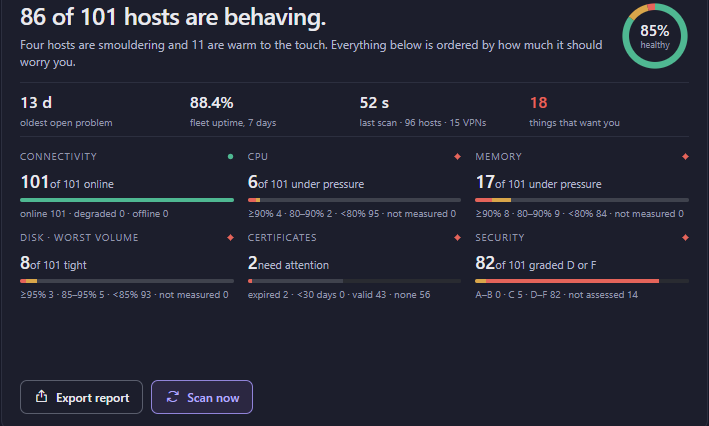
Rapitt closes all three. It holds one tunnel per client network and scans every site at the same time. It turns what each scan gathers into a security grade with the fix attached. And it inventories the devices around your servers on the same five-minute sweep, so the overview shows the whole estate ordered by how much each host should worry you.
What Rapitt monitors
Six modules share one sweep, one alert pipeline and one audit trail. Each links to a page with the detail.
Server security grading
Firewall, update age, TLS, local administrators, remote-control tools, encryption and Secure Boot, scored into one grade per host.
Server monitoring
Connectivity, CPU, memory, disk headroom, services, certificates and IIS sites for Windows and Linux servers behind any VPN.
Endpoint monitoring
An agent for Windows, Ubuntu and macOS: workstation security grade, application usage and unused software licences.
Network & IoT monitoring
Printers over SNMP, attendance terminals, routers, firewalls, Wi-Fi, IoT devices, domains and public IP addresses.
Alerts
E-mail, SMS and WhatsApp, routed per person by kind, severity and client, with quiet hours and a digest.
API & integrations
The HTTPS API the console itself uses, with scoped tokens, rate limits and a full audit trail.
How multi-site monitoring works
- 01 · Reach
Add each client's VPN once. Rapitt runs one tunnel pod per network, in its own namespace, and recovers dropped tunnels on its own. Where no tunnel can reach, a small agent reports in instead.
- 02 · Read
Every five minutes each host is read: health, services, drives, certificates and the security facts the grade is built from. In production, 96 hosts across 15 VPNs are swept in 52 seconds.
- 03 · Report
The overview opens with one sentence on the fleet, then orders hosts by concern. Alerts reach the right person once, and every action is in the audit trail under a name.
Who Rapitt is for
Managed service providers
Monitor every client from one console, with alert routing that keeps each client's events with that client's contacts. Licensed per device kind; clients are never counted.
Rapitt for MSPs →Enterprise IT
Business systems across many buildings and sites, with the security evidence an audit asks for and the printers and terminals staff depend on.
Security grading →Developers and integrators
Feed fleet status into a service desk, ERP or report through the same routes the console uses, with read-only or read-write tokens.
Monitoring API →servers scanned live in one production deployment
client sites, each reached over its own tunnel
to sweep 96 hosts across 15 VPNs
security checks per host, each with its fix
Frequently asked questions
What is Rapitt?
Rapitt is an IT infrastructure monitoring platform made by RapitAI in Dubai. It monitors servers, workstations and network devices across many sites and grades the security of each host from A to F, with the fix for every finding.
How does Rapitt reach servers behind client VPNs?
Each client VPN gets its own tunnel pod in an isolated network namespace, so every site is scanned in parallel without routes colliding. Servers that no tunnel reaches run a lightweight agent installed with one command.
What does the security grade measure?
Nineteen checks including firewall profiles, patch age, antivirus state, legacy TLS, SMBv1, LLMNR, local administrators, remote-control tools, drive encryption, TPM and Secure Boot. One critical finding decides the grade. See every check.
What is the workspace address on the demo form for?
It becomes your tenant subdomain — for example acme.rapitt.ai. Each organisation gets its own instance at its own address, and we hold the name for you until the demo.
How is Rapitt priced?
Licensing is per device kind — servers, workstations, printers, attendance terminals and network devices. Pricing is quoted on request. Read how licensing works.