Network, device and storage monitoring, beyond the servers
SNMP v3, topology, flows, traps and syslog, network storage, printers, attendance terminals, routers, firewalls, Wi-Fi and IoT - read on the same schedule as your servers, inside each client network.
Everything on the wire, not only the servers
Printers, biometric attendance terminals, routers, firewalls, access points, storage and IoT devices are on every network and in almost no monitoring tool. Rapitt reads them on the same schedule as your servers, from the monitor host or through each client’s tunnel, and keeps them in the same console, alerts and audit trail.
Network depth
Standard protocols, read-only, with the evidence shown.
SNMP v1, v2c and v3
Vendor OID templates for the values you care about, with alarms when a line is crossed. A value not answered is stored as missing, never as zero.
L2 and L3 topology
LLDP, CDP and bridge tables become a map of who is connected to what. Links inferred from a bridge table are marked as inferred.
Flows
NetFlow v5/v9, IPFIX and sFlow collection: top talkers, protocols and conversations, bounded so totals stay true.
Traps, syslog and webhooks
SNMP traps, syslog over UDP or TCP and inbound webhooks become events and, where they are problems, alarms with rules you write.
Network storage
SMB shares and NAS: online state, capacity, growth per day and “full in N days”, SMB dialect, signing and SMB1 exposure.
Discovery
Sweeps ranges you name and proposes servers, printers, terminals and network devices. Nothing is added without a person accepting it.
Network diagram
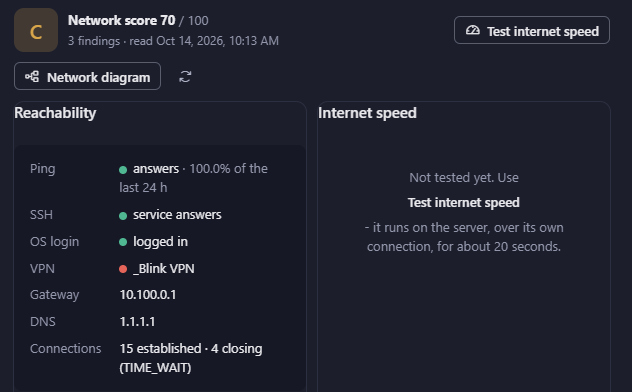
A PDF diagram of the network around a server, discovered from that server because only a machine on the segment can see it.
Domains and public IPs
Domain expiry, DNS record changes, mail health (SPF lookup count, DKIM, DMARC, MTA-STS), propagation across 24 public resolvers, blocklists and which services answer on each public IP.
WAN paths and circuits
Scheduled probes between sites record latency, jitter and packet loss; the circuit inventory measures utilisation against each circuit's committed rate; IP SLA and TWAMP results a router already holds are read alongside. A run that could not be made is shown as not measured, never as loss.
Routing views
BGP, OSPF, IS-IS and MPLS (VRFs, LDP sessions, TE tunnels) read from routers over SNMP, with every change of session state kept as an event. A table a router did not answer is shown as not answered.
SD-WAN controllers and carrier APIs
Read-only connectors to SD-WAN controllers and carrier JSON APIs show edges and links, with latency, jitter and loss where the controller gives them.
Link classification and traffic by class
Each WAN link is classified as MPLS, internet, metro Ethernet or another kind from the evidence held, with the evidence shown. Flows are split by class of service and AS number where the exporter sends them.
Address management and optical levels
Address blocks built from what Rapitt already knows, with used, seen, stale, reserved and free states, and conflicts flagged. Transceiver light and radio-link levels, with a fall flagged before a limit is reached.
The WAN capabilities have been tested end to end in Rapitt's own lab; they are not yet proven on customers' routers.
Printers over SNMP
Rapitt reads each network printer: status, every toner or ink level, drum and waste-toner state where the model reports it, and lifetime page count. A printer at 5% magenta becomes a low-consumables alert days before anyone runs out, and the page count gives a fair basis for cost allocation per department.


Attendance terminals
Fingerprint and face-recognition terminals hold payroll-critical data and are usually noticed only when one stops syncing. Rapitt reports whether each is reachable, how many users, fingerprints and faces it holds against capacity, how many attendance records it retains and whether its clock has drifted. It counts, and never reads the people or the records.
Routers, firewalls, Wi-Fi and IoT
Network equipment is identified by what it announces - vendor, model, firmware where available - and checked for reachability, open ports and the age of its management certificate. A gateway exposing SSH on the internet side, or a certificate about to expire, appears next to the servers it protects.
IoT devices - cameras, building controllers, specialist peripherals, unidentified embedded boards - are fingerprinted the same way. Many run old SSH servers or default web interfaces; listing them is the first step to segmenting them.


Network, devices and storage questions
How are devices discovered?
You define the address ranges. Rapitt sweeps them from the monitor host, over a client’s tunnel or from a bridge host, classifies what it finds with the evidence for each guess, and proposes them. Nothing is added or licensed until a person accepts it.
Which SNMP versions are supported?
SNMP v1, v2c and v3 (MD5, SHA and SHA-2 authentication, DES and AES privacy), with OID templates per vendor that you can edit. The client only reads.
Does the flow collector need agents on the devices?
No. Point NetFlow v5/v9, IPFIX or sFlow exports at your workspace’s collector. The collector is off until switched on, and your firewall must allow the exporter’s address.
Are network devices licensed separately?
Yes. Printers, attendance terminals, network devices and network storage each have their own cap. See pricing and licensing.
See it on your own systems
A walkthrough runs on your own estate. Reserve your workspace address while you book.